Does Learning a Few Words of the Local Language Actually Make Your Trip Better? We Asked Real Travelers

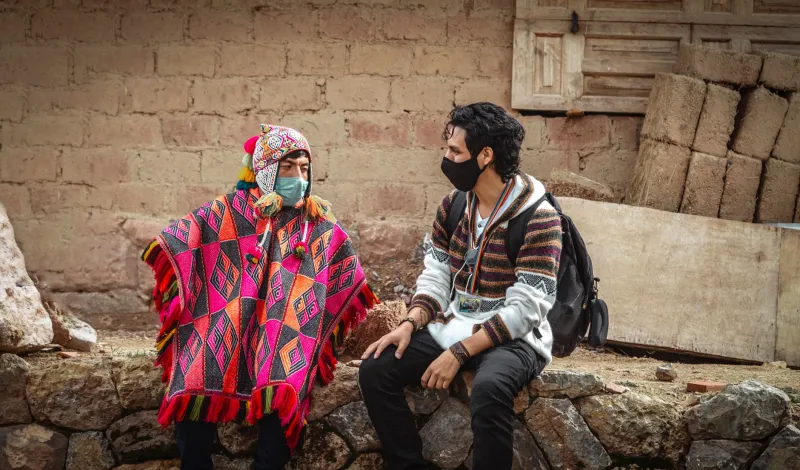
Photo: traveler learning local language phrases at market abroad, via www.fivemcar.com
There's a moment that every traveler knows. You're standing at a market stall in Marrakech, or a noodle shop in Chiang Mai, or a tiny bakery in Lisbon, and you realize you have absolutely no idea how to say what you want. You point. You smile. The transaction happens anyway. You walk away with your purchase and think: was that authentic? Did I miss something?
It's a question that doesn't have a clean answer — and that's exactly what makes it worth asking.
The Myth That Fluency Equals Connection
Let's get this out of the way first: you do not need to speak a language well to connect with people in a destination. Full stop. Anyone who's laughed with a stranger over a shared meal without sharing a single word knows this is true.
Marcela Torres, an American expat who has lived in both Buenos Aires and Barcelona, puts it bluntly: "I've seen people with zero Spanish have deeply moving, genuinely human experiences in South America. And I've seen near-fluent speakers completely miss the point of a place because they were too busy showing off their grammar."
The idea that language fluency is the gateway to authentic travel is, at its core, a kind of gatekeeping. It implies that the traveler who fumbles through a phrasebook is somehow having a lesser experience than the one who breezes through conversation. That's not really how human connection works.
But Here's What a Few Key Phrases Actually Do
That said, there's a real and measurable difference between showing up somewhere with zero effort and showing up with even a handful of deliberately learned phrases. And the difference isn't about communication efficiency — it's about signal.
When you attempt someone's language, even badly, you're sending a message: I see you. I tried. This place matters to me enough that I did some homework.
Diego Reyes, a tour guide based in Oaxaca who works with American visitors daily, describes it this way: "When someone walks up and says 'buenos días' and then immediately switches to English, it's fine — I expected English. But something shifts. There's a warmth that wasn't there before. It opens a door, even if we never walk through it in Spanish."
The phrases that seem to matter most, according to frequent travelers and guides across multiple continents, are rarely the transactional ones. It's not "where is the bathroom" that creates connection. It's the greeting. The thank you. The I'm sorry, I don't speak [language] well, but I'm trying. Those small admissions of effort carry surprising social weight.
The Language Barrier as Accidental Adventure
Here's an angle that doesn't get enough credit: sometimes not understanding the language is what makes something memorable.
Ashley Kim, a travel blogger from Portland who has visited 34 countries, describes getting on the wrong bus in rural Japan because she couldn't read the sign. "I ended up in a tiny coastal town that wasn't in any guidebook. I ate at a restaurant where I ordered by pointing at a plastic model in the window. The owner's daughter taught me three words in Japanese. It was one of the best days of my entire trip."
The discomfort of not knowing — the problem-solving, the improvisation, the reliance on human generosity — can produce some of the richest travel memories. A perfectly narrated, perfectly translated experience can sometimes feel like watching a documentary instead of living inside one.
Practical Language Hacks That Actually Move the Needle
If you want to add some linguistic texture to your next trip without enrolling in a six-month Duolingo streak, here's what actually works:
Learn the greeting and the apology. "Hello," "good morning," "excuse me," and "I'm sorry, I don't speak [language]" cover an enormous amount of social ground. These phrases signal respect and disarm defensiveness before it starts.
Download Google Translate's offline language packs before you fly. The camera translation feature — where you point your phone at a menu or sign and it translates in real time — is genuinely life-changing in countries with non-Latin scripts.
Ask locals to teach you something. Not in a performative way, but genuinely. "How do you say delicious in Thai?" is both a compliment and an invitation. People almost universally enjoy teaching their language to someone who's curious.
Use voice translation in real-time conversations. Apps like iTranslate and Google Translate's conversation mode have gotten remarkably good. Using one openly, with a shrug and a smile, reads as effort rather than laziness in most cultural contexts.
Learn the numbers. Markets, taxis, and small shops all involve numbers. Knowing how to understand a price quoted to you — even roughly — changes the dynamic of every transaction.
When Language Skills Actually Backfire
This one's less talked about but worth knowing: intermediate language skills can sometimes create friction that basic or zero skills don't.
Speakers who are conversational but not fluent can accidentally signal that they understand more than they do, leading to misunderstandings that wouldn't have happened with clearer communication from the start. There's also the issue of confidence outpacing accuracy — making commitments or agreements in a language you half-understand can go sideways in ways that pointing and smiling simply can't.
Several expats in France specifically mentioned this phenomenon. "Americans who studied French in high school sometimes come in with this energy like they've got it handled, and then something goes wrong and nobody knows why," says Claire Dubois, a Paris-based guide. "The traveler who arrives saying 'I don't speak French, please help me' gets more grace, honestly."
The Real Takeaway
Language and travel have a complicated, beautiful, non-linear relationship. Speaking the local language fluently can deepen certain experiences — nuanced conversations, humor, literature, local news — in ways that translation simply can't replicate. But it isn't a prerequisite for connection, authenticity, or a genuinely great trip.
What matters more than fluency is attitude. Curiosity. The willingness to be a little lost and a little humble. The readiness to try, fail, laugh at yourself, and try again.
Learn a few phrases. Download the translation app. And then put the phone down sometimes and just be present in the place you worked hard to get to. Your world awaits — you don't need perfect grammar to explore it.